The Fifth Wall: Why the Ceiling is 2026's Most Interesting Surface
For years, an accent wall was the safe way to use wallpaper. One wall, usually behind the bed or the sofa, got dressed up while the other three stayed quiet.
It worked, but it also did something we've never loved at Talking Walls: it split the room into the interesting part and the leftover parts.
This year, people have caught on to our advice and are looking up when selecting that one wall to paper. The ceiling, long treated as the place you roll on white paint and forget, has become the surface everyone is talking about. It even has a special name now: the fifth wall. Papering it is the wallcovering move defining 2026.
Why wallpaper your ceiling in 2026?
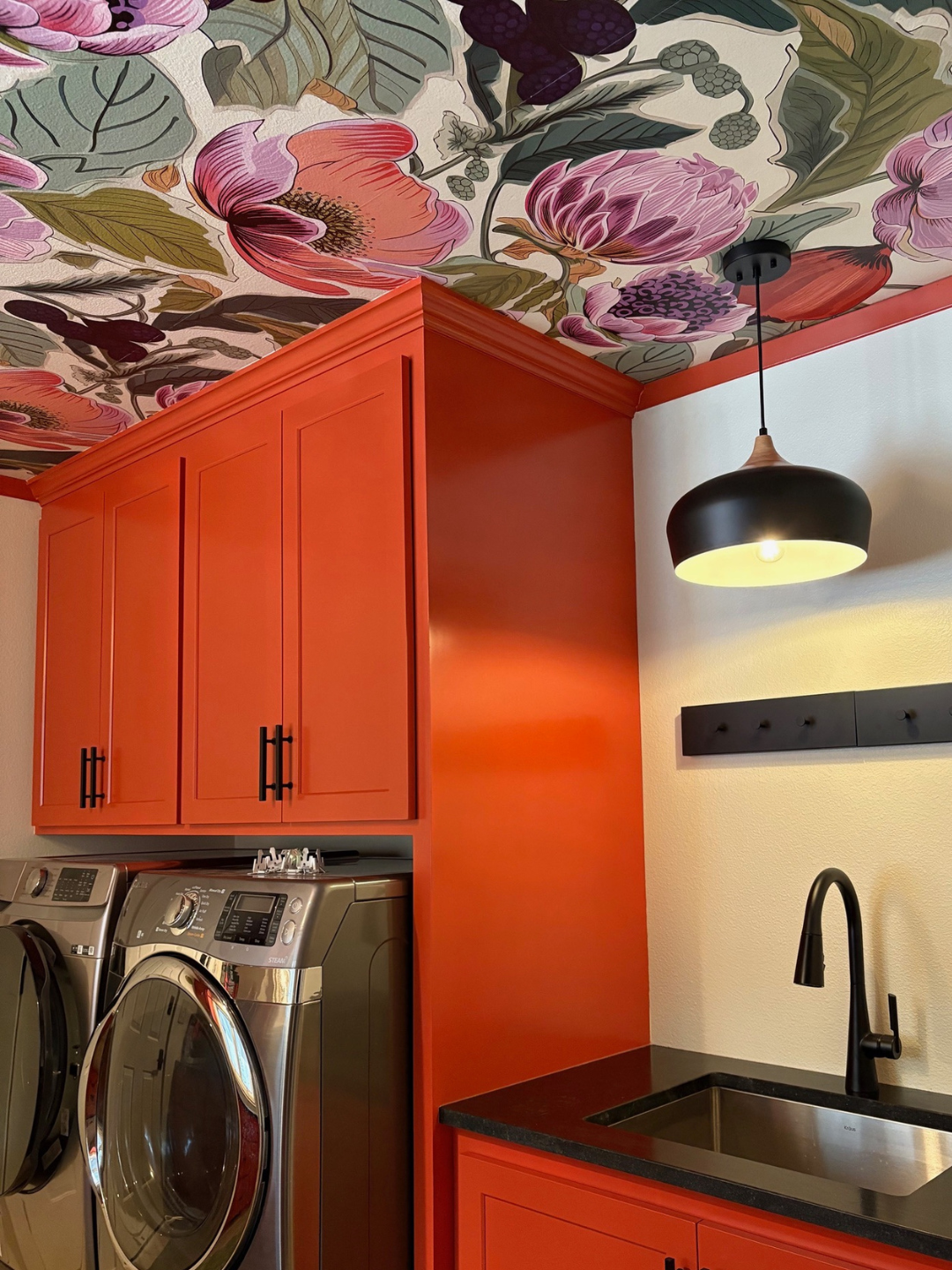
Walk into a room, and your eye travels. It catches the art, the window, the rug, and then (more than you would expect) it drifts upward. A bare ceiling is a held breath. A papered one finishes the thought.
There is a practical reason it works better than the accent wall approach, too. An accent wall draws a hard line: this wall matters, those don't. A papered ceiling does the opposite. It wraps the room. The pattern overhead pulls the whole space together, instead of drawing your eye to one wall and leaving you wondering why it stops there.
It also solves problems that paint cannot. A low ceiling papered in a small, light pattern can feel taller. A large room with high ceilings papered in something deep and saturated feels held, almost cupped. Awkward architecture, a slope, a dormer, an old beam nobody can move, often looks deliberate the moment it is papered, because pattern reframes a flaw as a feature.
The challenge of wallpapering your ceiling
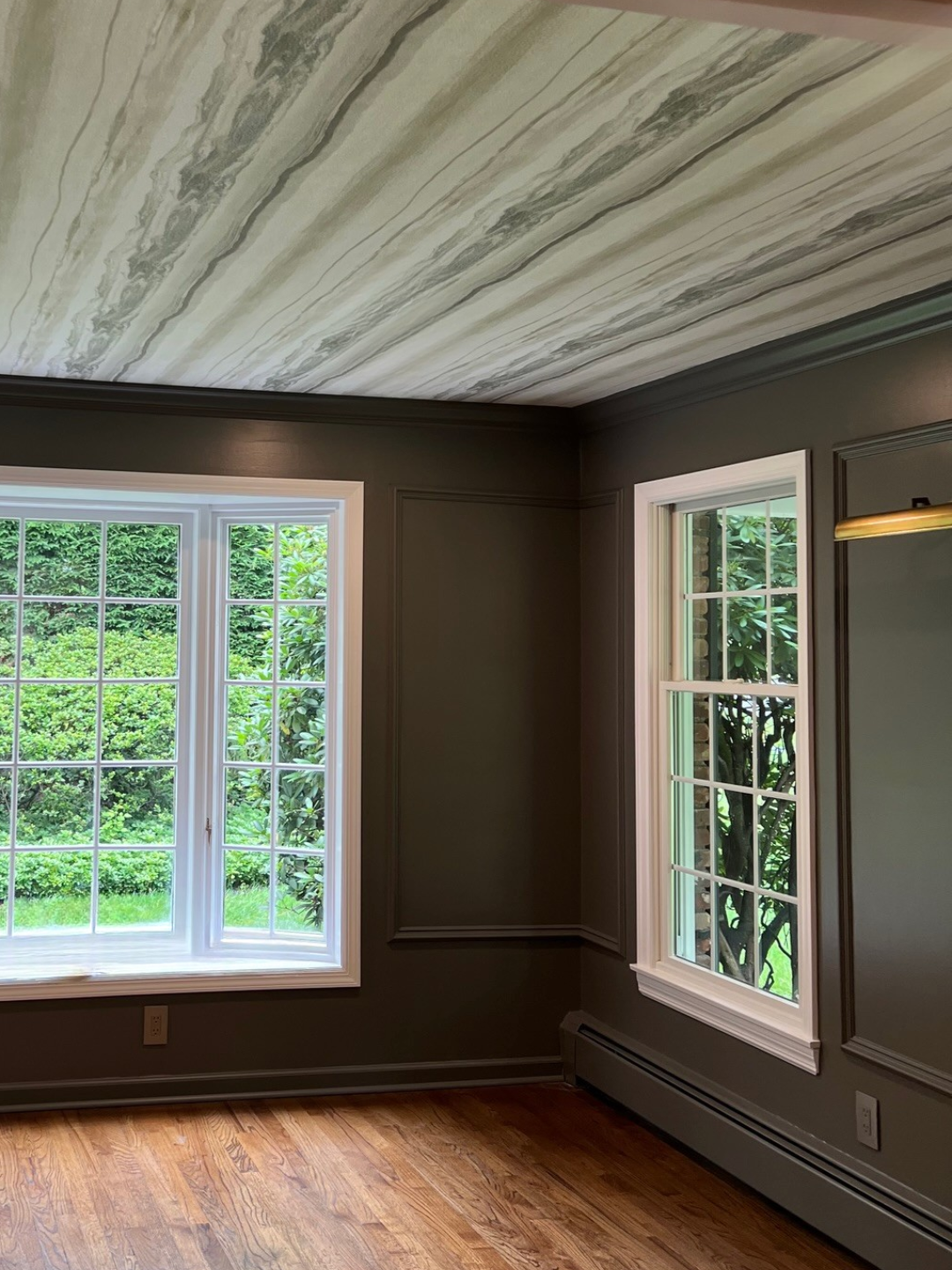
Here’s the honest version: a ceiling is not where you learn to hang wallpaper.
Gravity works against you the entire time. Light rakes across a ceiling at an angle no wall ever sees, which means every seam, every bubble, every patch of careless prep shows. And direction matters far more overhead than it does on a wall. Strongly vertical patterns tend to look stranded on a ceiling. Non-directional and all-over patterns, the ones that read the same from any angle, are the ones that settle in and look like they were made for the ceiling.
This is exactly the kind of decision that is easy to get wrong alone and easy to get right with guidance. Scale, orientation, finish, and the way a paper behaves under your room's specific light are the difference between a ceiling that looks intentional and one that looks like a near miss. Matching the paper to the room, then coordinating an installer who genuinely knows how to hang a ceiling, is the kind of thing worth getting right the first time.
Which ceiling should you wallpaper first?
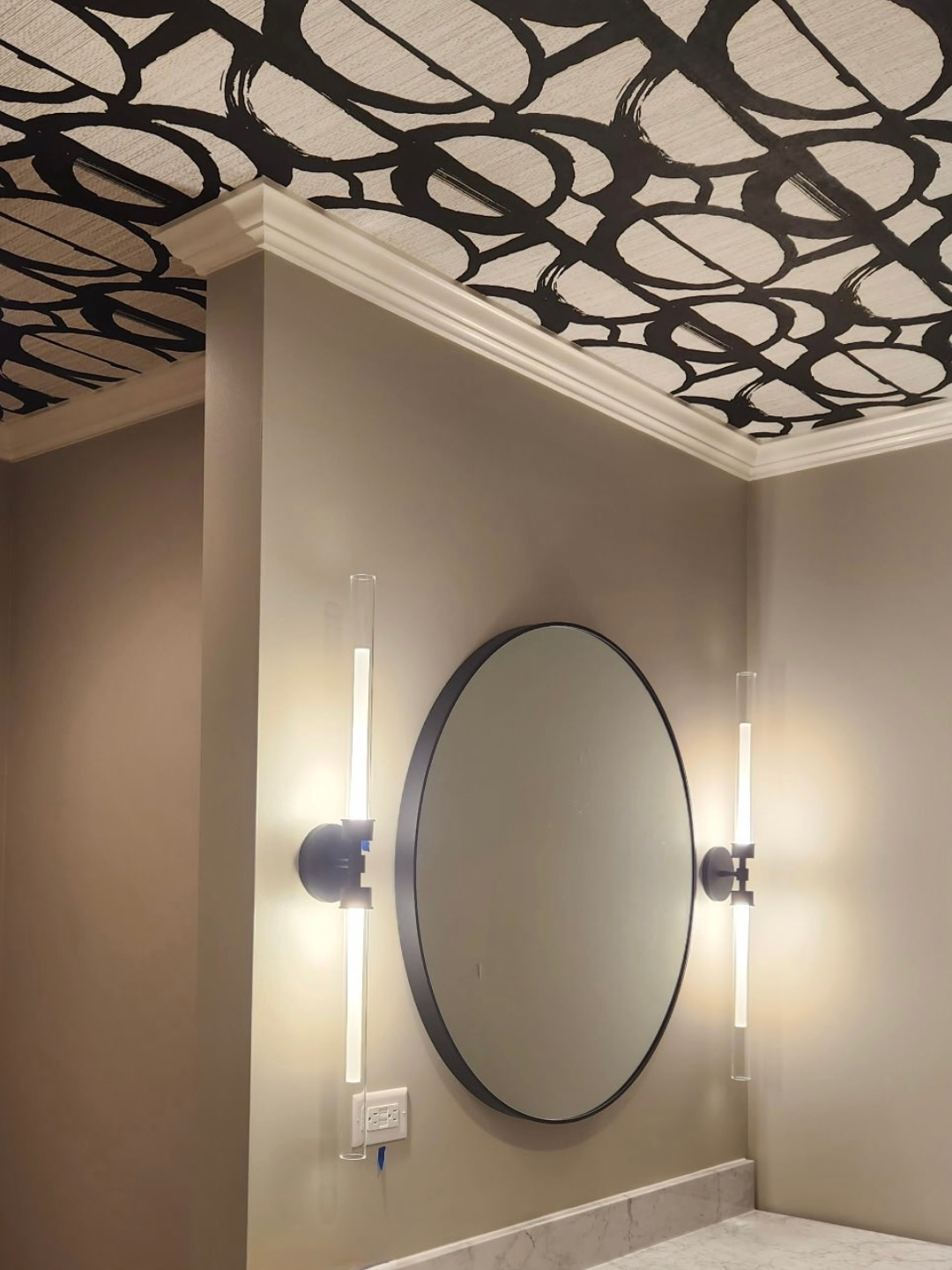
A powder room is the lowest-risk, highest-reward place to begin. It’s small and guests always notice it. A bold paper overhead in a tight space is the kind of thing people remember.
Bedrooms are the other natural starting point, for a reason most people overlook: the bedroom is the one room where you actually lie down and look at the ceiling. A soft, enveloping pattern there earns its keep every single night.
If full commitment feels like a leap, the inside of a coffered ceiling, a tray, or a reading nook gives you a contained panel to paper. You get the effect without papering the whole sky.
Wallpapering ceilings: the takeaway
An accent wall asks one wall to carry the room. The fifth wall asks the whole room to come together. If you’ve been staring at a blank ceiling wondering whether it could be more, it can. Stop by the showroom or book a consultation and we’ll figure out what your fifth wall is asking for.
Every wall has a story. The one over your head has been waiting its turn.
From the editor
We've been papering ceilings for years, long before anyone called it the “fifth wall.” It was never a trend to us, only one of our favorite ways to finish a room. We love watching more people fall for ceilings the way we always have.
If this is the year you look up, we'd love to help you find a paper worth lying back and staring at.
- Jodi